Reading · Spirituality

Lectio Divina Revisited

graphic depiction of a flaming chalice on a blue quilted background

The practice of reading, thinking, and praying about a line of scripture was a frequent exercise during my Franciscan and Benedictine school years.  At the time, I did not know this by its Latin name, Lectio Divina, but I received a renewed introduction to this practice last evening.

Possibly because of the widespread dissemination of the Rule of St. Benedict, I associated the four-step practice:  read, meditate, pray, contemplate, with St. Benedict (480-547 CE) when its origins are earlier and have been adapted through time.  There is a Franciscan variation designed by St. Clare of Assisi (1194-1253 CE) and, following St. Ignatius of Loyola (1491-1556 CE), the Jesuits expand their mediation into action.

Recognizing that wisdom may be drawn from many sources, a 21st century adaptation of the Lectio Divina encourages the participant to dwell on sacred words beyond just those of a biblical origin but still integrates four thoughtful steps:  begin, pause, reflect, contemplate.

Begin:  Read the text slowly.

Pause:  Let the words settle.

Reflect:  Meditate, pray, or write.

Contemplate:  Identify what the text calls you to do.

The appeal of Benedict’s Divine Order is that each day’s text is predetermined. The reader joins a communion of others contemplating those same words.  There is extra work required to expand the Lectio Divina to include a modern collection of poetry. Today, on a third Thursday Gathering of Poetry, I will begin my Lectio Divina with words from Lucille Clifton.

True, this isn’t paradise,

but we come at last to love it

for the sweet hay and flowers rising,

for the corn lining up row on row,

for the mourning doves

who open the darkness with song,

for warm rains and forgiving fields,

and for how, each day,

something that loves us

tries to save us.

Graphic credit:  © Peg Green

Spirituality

A Year of Choices

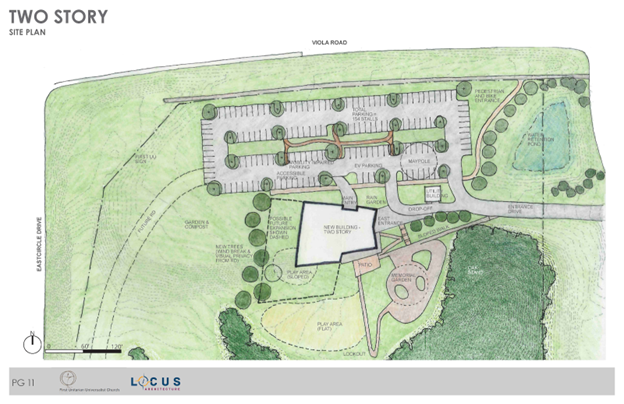
architectural drawing showing the potential layout on the new church property prepared by Locus Architecture
A preliminary design from Locus Architecture and one of many choices

After years of discernment during which we studied what was merely possible, defined what might be potential, and created a long wish list, 2023 has become a year of choices.  Two congregational votes clearly defined our direction.  Our first choice being the “stay/go” vote in January which set us firmly on the path to leave a building that has been home for 55 of our 157 years in Rochester.  Then came the second and equally momentous April vote authorizing the purchase of 38 Acres on Viola Road – that intersection of public witness and preserved wilderness – our choice of place where this liberal faith community may thrive.  And, our choices continue.

Locus Architecture presented two preliminary designs earlier this month after wading through a very long wish list, reviewing pages and pages of notes which captured the ideas voiced at more than 15 listening sessions held this spring, and participating in hours of conversation with the Building Our Future team.  The emphasis being on “preliminary” since our task of choosing continues:  1-story or two?  What constitutes the best blend of adjacencies?  Sanctuary and large gathering space on one level or large gathering space leading directly to the wide outdoors?  Ground or roof-mounted photovoltaic system or a combination?  Do we simply meet “code” or exceed minimum building requirements, especially if we feel the code crimps our values.  And, through all these discussions, just out of sight but waiting in the wings, are the financial decisions.  Just what will it take to realize our choices and turn our vision into constructed reality?

Based on the voices of the congregation, the Building Our Future team crafted a Vision Statement for the Building and the Land.  This statement introduced the architects as they presented their preliminary designs to the congregation; it was shared again at the dedication of the land on a sunny Sunday afternoon, September 17, and it is frequently chosen as chalice lighting words to focus our work at building team meetings.  Every day these words guide our choices.  In the days, weeks, and months ahead, more opinions will be needed from each member and friend of the congregation before we break ground in September 2024 and dedicate a new building a year later.  We do so with the hope that each choice will work towards our vision.

A Vision Statement for the Building and the Land

May we:
Welcome people with inclusive spaces and universal access.
Nurture spirituality and personal growth with beauty, art, and inspiration.
Practice justice with eco-restorative design.
Expand our community with flexible and multi-purpose space.
Create joy and resilience with places for play.
Care for sacred space to honor ancestors and nature.
Grow by embodying the intersection of public witness and preserved wilderness.

May it be so.  Amen.

Graphic credit:  © Locus Architecture