
Spirituality

Creating Margins

geese on open water with snowy trees in foreground

If there were weather badges, I would wear winter proudly on a scout-like sash. When friends question why we live in Minnesota, this land of 10,000 frozen lakes, I extol the efficiency of our Toro electric snowblower. When family members encourage us to move where winter temperatures are more moderate, I describe the warmth of my 10-inch, shearling-lined L.L. Bean boots and the safety of their legendary chain-tread sole.

In November and December, the blog posts I was reading, the poetry that landed in my in-box, and even the Sunday morning worship readings often focused on the change of seasons – autumn to winter; harbingers of shorter days and chilly winds necessitating down filled jackets. While not going so far as to advocate hibernation like a black bear, these readings encouraged taking a cue from nature to rest; to slow down and allow space for reflection and, maybe, creativity.

On winter solstice we light candles and sang of that “gentle darkness soft and still.” This year, more than any other, I felt the need to rest and re-charge. As I left church that evening my intention was to breathe deeply; appreciate the dark evening sky and embrace the quiet.

Yet just 10 days later, amidst bubbly toasts and video images of firework displays from Sydney to London, I was ready to surrender to mass media’s flurry of new year’s suggestions all urging “do more.” It was as if the small act of pinning a new calendar on the kitchen wall infected my mind. Rather than mere seconds passing at midnight, one day to the next, one year to the next, I felt I was eons beyond that “gentle darkness soft and still.”

Musician Carrie Newcomer helped me step back from that frenzy and from creating a checklist of busy work, a worksheet of old actions. She proposed moving away from New Year’s resolutions, the resolving of old problems and shifting to New Year’s revolutions. She wrote:

As January progresses, I continue to be resolute in my decision to join Carrie Newcomer with a New Year’s revolution. I will strive to revel in that which gives joy (despite the fractious political environment.) To explore the art of creating margins and leaving space for the unexpected – whether walking in the woods, discovering a previously unknown poet, or answering a call to justice. To remain open to the changing world “full of things that have never been.”
Reading

A Gathering of Poetry | January 2024

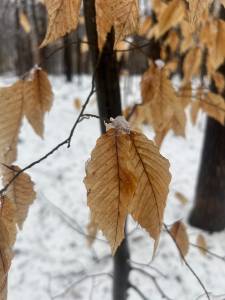
branches of yellow leaves against snowy backdrop

As always, Carrie Newcomer offers inspiration in song and verse.  I have been saving her poem, Blessings, to share with you on this third Thursday of January, Gathering of Poetry. Perfect as the old year ends and new days unfold…

Blessings

May you wake with a sense of play,
An exultation of the possible.
May you rest without guilt,
Satisfied at the end of a day well done.
May all the rough edges be smoothed,
If to smooth is to heal,
And the edges be left rough,
When the unpolished is more true
And infinitely more interesting.
May you wear your years like a well-tailored coat
Or a brave sassy scarf.
May every year yet to come:
Be one more bright button
Sewn on a hat you wear at a tilt.
May the friendships you’ve sown
Grown tall as summer corn.
And the things you’ve left behind,
Rest quietly in the unchangeable past.
May you embrace this day,
Not just as any old day,
But as this day.
Your day.
Held in trust
By you,
In a singular place,
Called now.

You can join the poetic fun every third Thursday as shared by Bonnie and Kym.

Bibliographic notes:  From The Beautiful Not Yet:  Poems, Essays and Lyrics.  Available Light Publishing.  ©2016 Carrie Newcomer.

Photo credit:  © Carrie Newcomer

Spirituality

All Souls: Sunday Reflection (a tad late)

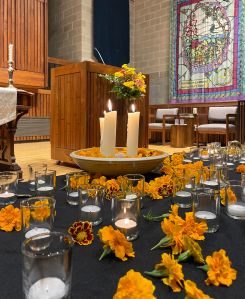
Yesterday, as I sat in a pew of an old Lutheran church nestled among recently harvested rolling fields, I hummed along as my friend sat at the organ and played For All the Saints.  I reflected back a week to our All Souls service.  In the days leading up to All Souls Day, Richard and I toted five pots of marigolds to church.  In the spring, small seedlings had been planted in hopes of warding off nibbling critters while anchoring the corners of our garden; they provided brilliant color throughout the summer; and then, with frost warnings forecasted, these hardy plants were transplanted into pots and moved under grow-lights to thwart the season’s chill just so the bright blossoms could render one last service scattered among a hundred clear glass votive lights on our Altar of All Souls – a visible symbol of remembrance to honor our ancestors.

I believe it says a lot about who we are as individuals, as a church community, as a society, in how we honor our dead.  In our ever more hectic, every day world with corporate-driven practices that define grief in HR policy and relegate just three days for sorrow before it is back to business as usual, there is a lot to learn from studying the traditions of other cultures.

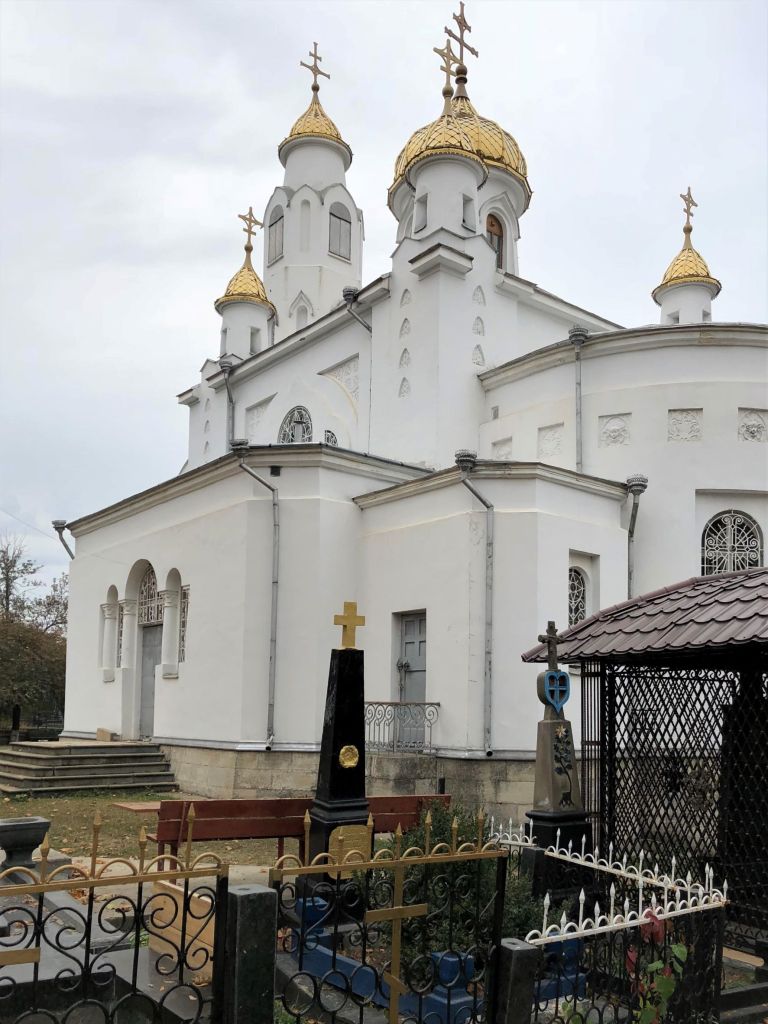
In the Romany graveyards of Eastern Europe, nestled next to gold domed, centuries-old churches and scattered among the headstones of family plots there are often elaborate gazebos built with permanent tables and benches that provide regular gathering places.  When family and friends come together they bring their tastiest culinary treats, a portion to be enjoyed among the living and a portion left for the spirits.  Flowing with the libations are the shared memories which braid together the stories of the departed and the lives of the next generation.

In her poem, Into Every Conversation, Carrie Newcomer writes:

Into every conversation,
At least those that matter,
I carry my stories like a book
Tucked under my arm or secured deep in my heart.
A forward written by the ancestors,
Side notes and commentary in the margins, 
Written by mentors, tormentors, and friends.

Not that we should walk lock-step in the beliefs of our ancestors because that would render us unable to see injustice and work for change; unable to recognize inequity and dream of the possibility of a different world.  Rather, in remembering those who have come before us, we need to build on our heritage bringing together the good news and those parts in need of transformation.

Last Sunday, we lit candles for those whose memories live in our hearts.  At a time when the old tales speak of “the thin veil between worlds” – of All Hallows Eve and All Souls Day – it was good that we gathered and remembered.  It was good that we spoke aloud the names of those who have died.  And, having been heard by family and friends and even strangers we acknowledged those individuals.  In the words of the poet we continued to “carry our stories like a book tucked under our arms or secured deep in our hearts.”

Spirituality

“You Can Do This Hard Thing”

Last month, I faced a hard task.  Hard, not in the sense of strenuous work or tough negotiations; not climbing a mountain or training for a marathon or anything else that could really be deemed difficult.  No, it was hard because I was not ready.  It was hard because I simply did not want to do it.  Likewise, my first attempt at this post was so “Wendy Whiner-ish” that I had to set it aside. I knew I needed an attitude adjustment. I just didn’t know when or from whom that inspiration might come.

You can do this hard thing, 
You can do this hard thing
It's not easy I know but
I believe that it's so
You can do this hard thing.

When Richard received his Parkinson’s Disease (PD) diagnosis on July 23 last year, my first, librarian-like reaction was to dig into the research.  I relied on Mayo’s website for my introduction; I joined the Parkinson’s Foundation’s online community which generates lots of helpful emails on a regular schedule; I even downloaded the 174 page care-giver’s guide.  I think that is what stymied me.  I wanted the Cosmo version of a guide.  I wanted 10 easy steps to understanding a complicated, incurable disease or 10 easy strategies to supporting without smothering.  I did not want; I could not handle 174 pages.  I reverted to learning by osmosis – simply observing the changes I saw or listening to what Richard was discovering since he was doing the hard work of research.  I did give PD a new name.  In my head this progressive disorder that affects the nervous system became FD – that F*****g Disease.

Hearts hung like laundry
On backyard clothes lines
Impossible just takes
A little more time

This past weekend, I had the special privilege to spend time with Carrie Newcomer , a musican and songwriter the Boston Globe describes as a “prairie mystic.”  As I served as chauffeur between hotel and church, sat through a rehearsal and sound checks, enjoyed a concert and particpated in two Sunday morning services at which Carrie and her accompanist, Gary Waters, were the featured musicians, Carrie’s poignant stories, inspirational lyrics, and haunting melodies jumpstarted my attitude adjustment.  I felt I could step away from selfish introspective, from frustrated inability to “fix” the problem and into the simple acknowledgement that Richard and I will continue to adapt and manage.