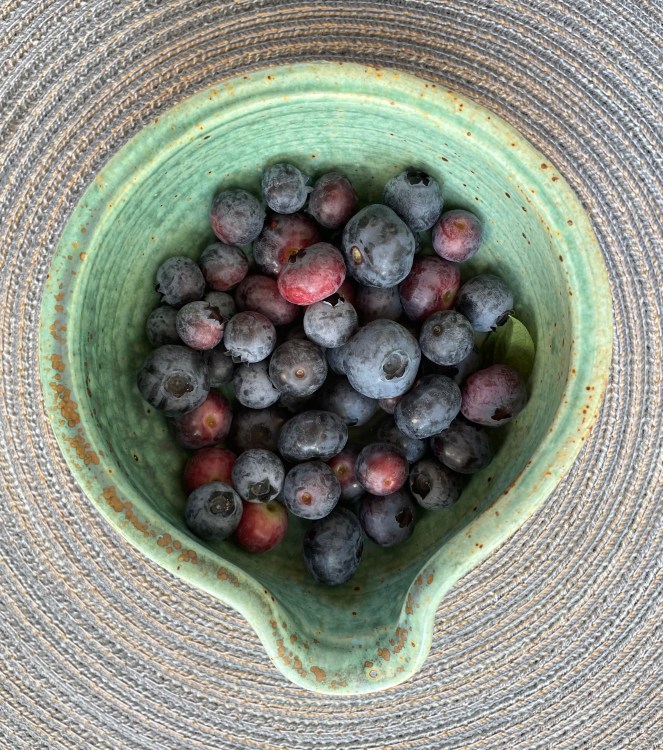
It was the best of summer times – with plentiful potatoes and just the right sized zucchini, it was the worst of summer times – with chipmunks stealing succulent blueberries and cucumbers that overwhelmed. Almost making me regret planting this last garden on First Street all the while exploring options for next summer’s raised beds on Solstice Place. While carrots were not part of my planting plan, Leah Naomi Green’s poem is fitting for this month’s Gathering of Poetry.
Carrot
Take all summer, your ember
from the sun, its walking meditation.
Store it in small vaults of light to keep the rest of us
when winter seals around each day.
We'll flicker to the table.
We'll gather to your orange flame.
Please excuse my blatant plagiarism of the hallowed Dickens Tale and for being a tad bit late in joining Bonnie and Kat for this Gathering of Poetry.
I offer a poetic homage for this month’s third Thursday entitled June, although I feel it is more aptly named Summer. (But who am I to challenge John Updike’s wizardry of words?)
As a child of the 50s, Updike captures the essence of my long-ago summer days. Mornings that began with my name sing-songed at the backdoor screen calling me out to play; intense kickball games in the cinder alley with the bases unevenly spaced – the corner of the Davis garage, the edge of the Bush’s stone wall, and the large trunk of their oak tree; afternoons spent biking or skating round and round the block each rotation made more challenging as we fixed metal clamp on roller skates to our scuffed white summer tennis shoes; and then the languid evenings of hide and seek or firefly hunting as we counted our treasure trove of lighting bugs captured in empty Mason jars.
From July 2007 through August 2011, I stepped back into that magical time as we hosted Summer Camp for our nephew. Most often these carefree days, filled with fishing and crafts, reading and games, took place at my parents’ cabin on Lac Courte Oreilles in northern Wisconsin. There was one summer when hospice home care made that trip impossible and we shifted our play days to Rochester where evening walks replaced boating excursions but with no less fun in the “live-long light.”
June
The sun is rich, And gladly pays In golden hours, Silver days,
And long green weeks That never end. School’s out. The time Is ours to spend.
The playground calls, The ice-cream man, And, after supper, Kick-the-can.
The live-long light Is like a dream, And freckles come Like flies to cream.
As someone who loves to “play in the dirt” and is anxiously awaiting the thawing of my raised beds, I appreciate the imagery and reminders offered by Elizabeth Alexander – poet, musician, composer, and fellow Minnesotan. Her advice to “trust the seeds” goes beyond just the feel of the garden trowel in my hand and extends to good advice for life in these scary, turbulent times.
Trust the Seeds
Trust the seeds, although they lie in darkness, Stirring beyond your watchful eye. Though they may not flower as you dreamed they would, When the planting’s over you must trust the seeds.
Some soon bloom to fill your heart with wonder, Some only after you are gone, You must give them freedom to grow as they should. Give them room to spread their roots, and trust the seeds.
In your heart, you know that some may wither, All you can do is hope and pray. Some will rise up grander than you dreamed they could. There is joy in planting if you trust the seeds.
Writer Danielle Coffyn offers a comedic (but true) view of the Adam and Eve Genesis story in her new poetry collection being released on International Women’s Day, March 8, 2025. I hope you enjoy If Adam Picked the Apple from Coffyn’s anthology by the same title for this Gathering of Poetry on January’s third Thursday.
If Adam Picked the Apple
There would be a parade, a celebration, a holiday to commemorate the day he sought enlightenment. We would not speak of temptation by the devil, rather, we would laud Adam’s curiosity, his desire for adventure and knowing. We would feast on apple-inspired fare: tortes, chutneys, pancakes, pies. There would be plays and songs reenacting his courage.
But it was Eve who grew bored, weary of her captivity in Eden. And a woman’s desire for freedom is rarely a cause for celebration.
And thanks to Bonnie and Kat for bringing Gathering of Poetry into a new year.
Mid-December and we have only a light dusting of snow, nothing like the hip-high drifts of my childhood. For this third Thursday Gathering of Poetry, I will celebrate a winter trio: snow (not yet fallen), winter solstice, and Nikki Giovanni’s Winter Poem.
once a snowflake fell on my brow and i loved it so much and i kissed it and it was happy and called its cousins and brothers and a web of snow engulfed me then i reached to love them all and i squeezed them and they became a spring rain and i stood perfectly still and was a flower
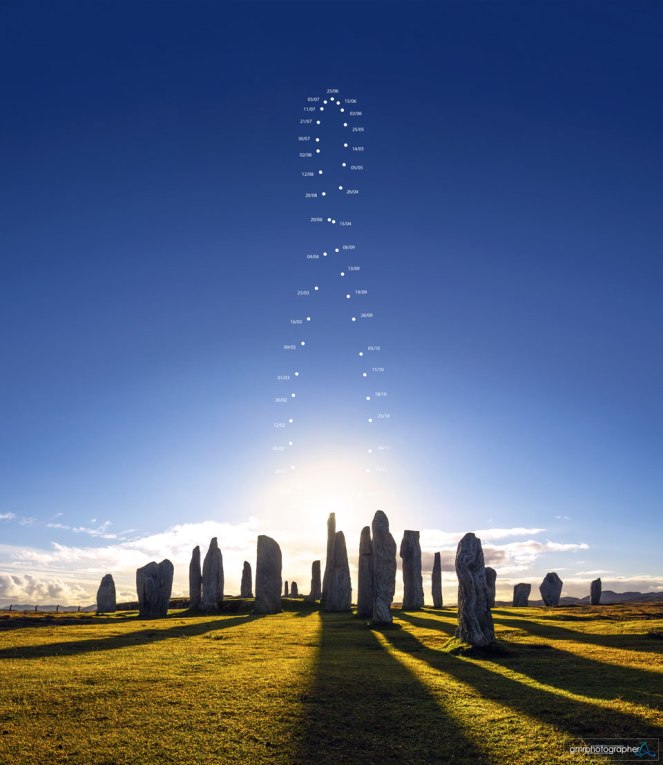
NASA technical description: An analemma is a composite image taken from the same spot at the same time over the course of a year. The tilt of the Earth axis and the ellipticity of the Earth’s orbit around the Sun create the analemma’s figure-8 shape. At the solstices, the Sun will appear at the top or bottom of an analemma. The featured image was taken near the December solstice 2022 at the Callanish Stones, near the village of Callanish in the Outer Hebrides in Scotland, UK. Source: NASA Astronomy Picture of the Day
With the conclusion of an emotional campaign season and election results that presented a clear dichotomy between progressive inclusion and conservative isolationism, this poem written on November 6 by Steve Garnaas-Holmes served as balm for my wounded spirit. For those still reeling and wondering what the future holds, I hope you, too, find comfort in these words for the third Thursday Gathering of Poetry.
Take seriously your grief. It is love, stripped bare. Let it flow through you.
Trust that you are held. We all are held by the Beloved, the Broken-Hearted One, the One who Suffers most Deeply.
Know you are not alone. Millions bear your sorrow. Ancestors and even unborn generations walk with you gratefully.
Seek others who are tenderhearted. Receive all the grace you can. In the flesh is best, but even in spirit, know we are here.
Trust the Goodness. God has not given up on us. Through every disaster grace remains. Refuse to despair.
Choose courage over selfishness, trust over fear, love over anger. You do not know the end of grace.
There is much you cannot change, but bring healing where you can. We are not promised to be given light, but to shine with light.
Don’t become an enemy of the world and its brokenness. Stay tender. Become a source of comfort and joy for others. Let this purpose bear you through the darkness and you yourself will become light.
Take courage; trust grace; stay connected; practice love.
Steve Garnaas-Holmes is a retired Methodist Minister living in Montana who shares daily reflections at Unfolding Light. His weekday thoughts are “rooted in a contemplative, Creation-centered spirituality … which invites readers into a spirit of presence, compassion, justice and delight.” His blog is Unfolding Light, which is also the title of several volumes of poetry.
Every time I hear Amada Gorman read her poetry I shiver with inspiration. To be so young and yet so eloquent. This past summer in Chicago, during the Democratic National Convention, she walked proudly unto the stage and laid this challenge before each of us:
This Sacred Scene
We gather at this hollowed place because we believe in the American dream.
We face a race that tests if this country we cherish shall perish from the Earth, and if our earth shall perish from this country.
It falls to us to ensure that we do not fall for a people that cannot stand together, cannot stand at all.
We are one family, regardless of religion, class or color. For what defines a patriot is not just our love of liberty, but our love for one another.
This is loud in our country’s call, because while we all love freedom, it is love that frees us all.
Empathy emancipates, making us greater than hate or vanity. That is the American promise, powerful and pure. Divided, we cannot endure but united, we can endeavor to humanize our democracy and endear democracy to humanity.
And make no mistake, cohering is the hardest task history ever wrote, but tomorrow is not written by our odds of hardship, but by the audacity of our hope, by the vitality of our vote.
Only now, approaching this rare air, are we aware that perhaps the American Dream is no dream at all, but instead a dare to dream together.
Like a million roots tethered, branching up humbly, making one tree, this is our country. From many, one; from battles won; our freedoms sung; our kingdom come has just begun.
We redeem this sacred scene. Ready for our journey. From it together, we must birth this early republic and achieve an unearthly summit. Let us not just believe in the American dream. Let us be worthy of it.
As friends return from this year’s Pilgrimage, I am drawn back to the sights and learnings of my own travels to Massachusetts in 2022 and especially our memorable day in Concord. We followed the same amble that Emerson would have walked to visit his friend Ralph, who had gone “…to the woods because I wished to live deliberately, to front only the essential facts of life.” And, it provides the perfect opportunity to re-visit Mary Oliver.
Going to Walden It isn’t very far as highways lie. I might be back by nightfall, having seen The rough pines, and the stones, and the clear water. Friends argue that I might be wiser for it. They do not hear that far-off Yankee whisper: How dull we grow from hurrying here and there! Many have gone, and think me half a fool To miss a day away in the cool country. Maybe. But in a book I read and cherish, Going to Walden is not so easy a thing As a green visit. It is the slow and difficult Trick of living, and finding it where you are.
On this third Thursday, check out the poetry Bonnie and Kat are sharing.
Bibliographic credit: Oliver, Mary. Devotions: The selected Poems of Mary Oliver. Penguin Press, 2017, pg 430.
Just as the poet reminisces about an evening’s stroll along Elm Creek, I recall our Summer Camp days spent on the shores of Lac Courte Oreilles. Where, in July 2006, Auntie Ann (that’s me) lost the frog but John Lac captured the snake.
An Evening's Stroll by Ed Blair
When July's sun has spent her fierceness on
The sweltering earth; I love to ramble then
Along the narrow banks of dear Elm Creek
And be for one short hour a boy again.
To make the rocks skip o'er the waters smooth
And see the frogs plunge from the water's edge,
And hear the gentle cooing of the dove
Among the elms and from the distant hedge.
Oh, boyhood days ne'er come so near to me
As in these strolls in Summer eve's twilight;
I view again the scenes I love so well
And watch the gentle coming of the night.
With a shout out to Bonny and Kat as we celebrate together a gathering of poetry every third Thursday.
When we brought our home in 1985, several feet of late winter, gray tinged snow hid garden treasures: chives and clematis by the back door, vibrant orange Oriental poppies along the (now gone) fence, and peonies lining the south side of the old garage. While a portion of the peonies were transplanted to Eau Claire, others remain anchoring various gardens on our small Kutzky Park lot. These delicate blossoms were battered in the late May storm that severely damaged the last remaining large elm tree so Jane Kenyon’s poem, Peonies at Dusk, put into words what is missing from my spring flower collection. Perfect for this month’s third Thursday’s Gathering of Poetry.
Peonies at Dusk
White peonies blooming along the porch
send out light
while the rest of the yard grows dim.
Outrageous flowers as big as human
heads! They’re staggered
by their own luxuriance: I had
to prop them up with stakes and twine.
The moist air intensifies their scent,
and the moon moves around the barn
to find out what it’s coming from.
In the darkening June evening
I draw a blossom near, and bending close
search it as a woman searches
a loved one’s face.