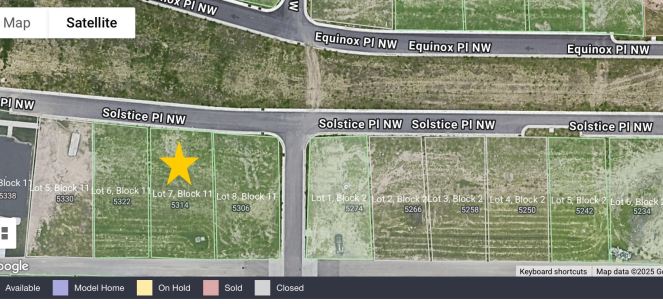
We have a site! Specifically, Harvestview Third, Lot 7, Block 11 located at 5314 Solstice Place NW. After looking at existing side-by-side townhouses, we will purchase a new “villa.” This will provide independent living on one level with no-step entry constructed on a 50×100 foot lot. Interestingly, this parcel is slightly larger than our current property, with the added benefit of HOA provided lawn care and snow removal.
Given the already high-costs for construction materials post-Covid and mix in an unstable market due to ditzy rhetoric about on-again, off-again tariff threats and we thought the price of new construction might be unaffordable. But after weighing the pros & cons of 30+ year old properties in need of new appliances and remodeled bathrooms versus new construction with greater energy efficiencies and various warranties, we will build. Next step – choices, choices, choices.
On a sunny March day, with meteorological Spring having just sprung, I have a Fall weekend booked for knitting. From September 18-20, I will join 100s of other knitters at the annual Knit Camp at the Coast virtual retreat. My registration is confirmed, complete with swag. The speakers’ roster is a who’s who of industry experts. As planned, workshop topics range from short rows to color saturation to changing gauge. With a sunny disposition, I will set aside my worries of potential scheduling conflicts – retreat vs. house move – and simply plan to defer packing and unpacking while acquiring new skills.
On 24 February 2022, Russia invaded Ukraine. While the White House claims the opposite, it does not change the truth we saw for ourselves. Television images of Russian tanks and bombed children’s hospitals. Interviews with World Central Kitchen Founder and Chef José Andrés as he and his teams provided hot meals for displaced people. And, on a personal note – hearing from Moldovan friends, with whom I shared many glasses of wine, that they were offering safe homes to Ukrainian refugees. Americans hung bright yellow and blue flags, churches conducted prayer vigils for peace, and sunflowers became the flower of choice, at least for a time.
With embarrassment, I watched a BBC live feed as an international relations meeting devolved into a shouting match intended to intimidate democratically elected President Volodymyr Zelenskyy while he visited the Oval Office. While Zelenskyy sought ongoing US support for Ukraine, the administration rudely rejected his warning to avoid putting too much trust in Vladimir Putin. These words of caution were not that of a flimflam man but from someone who has walked through the exploded rubble of the streets of his Capitol; a warning based on personal knowledge of broken Russian promises. My upbringing, with deep roots in southern hospitality and Swiss congeniality, requires treating a guest with respect. While I have only visited 1600 Pennsylvania Avenue, I believe it is the people’s house and basic rules of respect and dignity should prevail. That definitely did not occur yesterday.
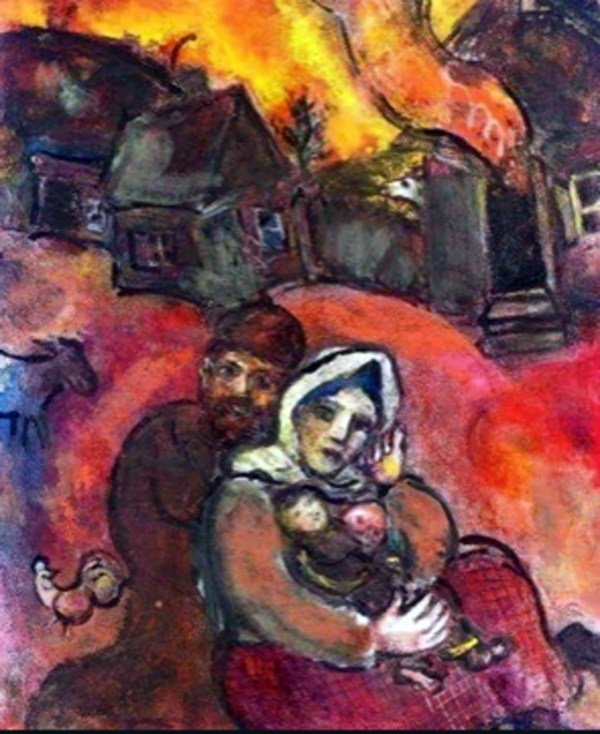
Art credit: Marc Chagall, 1887-1985. La Famille Ukrainienne, gouache, pastel and pencil on paper, executed circa 1940-1943.
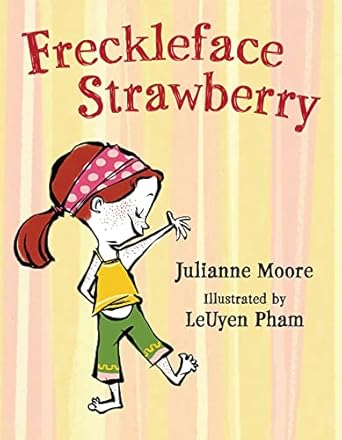
With the firehose of bad decisions spewing forth from this White House, I vacillate between trying to stay informed and wanting to ignore the mistaken path this country blithely follows. As a former children’s librarian, I am dismayed by the administration’s recent order to remove certain picture books from U.S. military schools. In an unstable world with bombs hitting targets in Gaza and Ukraine and civil wars in Sudan and Myanmar, I would think the Department of Defense would have more relevant tasks to undertake than pulling from its school library shelves Freckleface Strawberry by Julianne Moore and No Truth Without Ruth by Kathleen Krull.
Here is a brief synopsis in case you are not familiar with these two picture books.
No Truth Without Ruth – An age-appropriate biography of the life of Ruth Bader Ginsburg, from a small girl who chipped a tooth while twirling a baton to Supreme Court Justice making major decisions while donned in a black robe and her signatory lace collar.
Freckleface Strawberry – Tired of being teased because of her looks, the story tells of a young girl’s antics to hide her face before accepting her freckles.
While I may be eight years into retirement, my long-held belief in intellectual freedom as basic tenet of librarianship still rings true. As defined by the American Library Association: “Intellectual freedom is the right of every individual to both seek and receive information from all points of view without restriction. It provides access to all expressions of ideas through which any and all sides of a question, cause or movement may be explored.”
I encourage you to read these titles for yourself and determine whether these books are, as described by the administration, “radical indoctrination.” I think not but take a look.
Our search for a new house has begun. With help from Alex Mayer, we are looking for the “right-sized” dwelling with living space on one-floor and maybe even a no-step entry. We have loved our quaint 100-year-old home in this well-established neighborhood, but we are ready to relinquish worries about exterior maintenance, snow removal, and lawn care to a homeowners’ association (HOA).
While there are a multitude of variables beyond our control, we hope the search will follow a steady linear progression: view homes for sale, make an offer, close on the new property, remodel and/or renovate to our taste, move, and then finally put our house on the market. We have already discovered that modern home shopping is certainly easier than 40-years ago. From the comfort of our sunroom sofa, we review online listings; dismissing one as too big or another as too small, all the while hoping for that Goldilocks “just right” dwelling. On a deep-freeze day last week, we visited a side-by-side townhouse on two levels – nice but not quite right. Today, with a sunny blue sky, we will visit another listing that just went on the market yesterday.
Late afternoon postscript – Today’s townhouse also falls into the nice but not quite right category.
Mennonite Church USA et al. v. United States Department of Homeland Security et al., as filed on February 11, seeks to protect houses of worship as places of grace without government interference. More than two dozen Christian and Jewish denominations, representing millions of Americans, are co-plaintiffs in this lawsuit which asserts that ICE policy violates First Amendment rights of freedom of religion.
Throughout our country’s history, including the first administration of the current President, law enforcement considered churches, schools, and hospitals as “sensitive locations” protected from immigration enforcement. Among the many decrees effective on Inauguration Day, was a memo from the Department of Homeland Security rescinding the “sensitive locations” designation. This change in ICE policy makes way for immigration raids in churches even during religious ceremonies when refugees, asylum seekers, and immigrants might gather. The lawsuit confirms at least one such disruption during worship on a Sunday morning in Georgia.
As someone involved in liturgy, I want to focus on enriching the spiritual experience of participants; to lift the burden of a heavy heart, if only for a moment; to elicit inspiration through spoken words or sung lyrics. This change in government policy creates an unwelcome and unhealthy distraction. Now, I must shift my attention from the sacred to prepare for possible disruption.
The concept of sanctuary can be identified throughout history and across cultures, from Old Testament times to today. It saddens me that we must rely on the courts to determine that churches are different from coffee shops and strip malls. I sincerely hope Mennonite Church USA et al. v. United States Department of Homeland Security et al. is successful in protecting places of worship as holy and sanctified spaces.
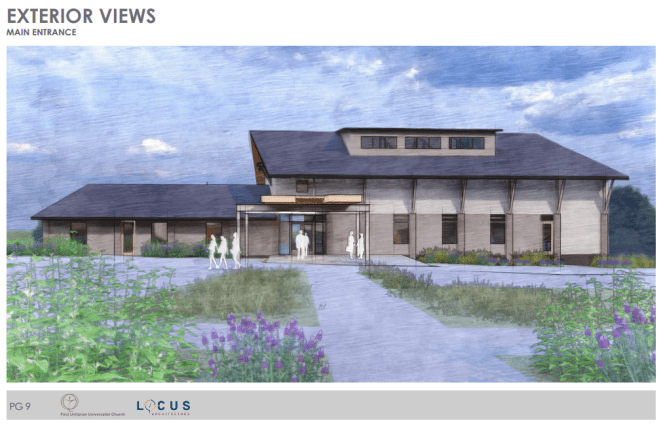
An exterior view from Locus Architecture following the schematic design phase of development.
I am a pen-and-paper note taker, a behavioral remnant leftover from long-ago college history courses. As we began discussing a new church home, it was natural that I would jot down ideas shared by congregants, whether during large group forums or even while enjoying a one-on-one coffee time conversation. Those notes evolved into an eight-page, single spaced, bulleted list. The ideas range from a visible entrance to natural light in the sanctuary; from an industrial kitchen to chairs with book racks for the hymnals; from energy efficient construction to a dedicated space for young adults. Some requests were overly broad – good acoustics. Others offered minute description – bench seating in the coat room for ease of putting on and taking off boots, with built in AC powered cubby holes to store and charge electric bike batteries during Sunday morning worship. Despite its length, the list contained very few contradictions. Even when there were preferences, for example, one-story versus two, Rev. Victoria Safford’s words captured the overarching sentiment which called for “a building that sits gently on the land.”
After seven years, through discernment, three congregational votes, a successful capital campaign, and reams of architectural renderings, we have a beautiful schematic design. Now we must pause.
There are a variety of factors conspiring against our project: current commercial interest rates are discouraging developers, and the design and location of our current building requires a unique buyer in a niche market. Add to this, the post Inauguration Day chaos and Presidential Executive Orders that, in the stroke of a pen, eliminated significant energy funding, as well as the threats of tariffs that will increase the costs of already expensive building supplies. A pause is prudent. My rational mind acknowledges that continuing to refine the architectural elements would be fiscally irresponsible, but my heart wants to buy a lottery ticket or host a bake sale or two or three. How to reconcile mind and heart?
With our most recent schematic design in hand, I decided to review the list and compare the dream with the elements on paper. In keeping with our vision statement for this land and the building: Do we have a design that will contribute to a compassionate and welcoming environment? How might this space contribute to our justice work? How inclusive have we been of the congregation’s creative suggestions?
Without the benefit of any scientific methodology, I rate our efforts: B+ to A-. The design incorporates many of congregants’ top priorities:
Large windows in the sanctuary with a panoramic southern view of the rustic landscape
A building footprint that can be expanded east and west to meet growth over the next 100 years
Easy workflow in a large kitchen.
Some highly desirable elements such as, the solar array or geothermal heating and cooling, are currently off the table due to cashflow. At best, we will build the needed infrastructure and add these highly-desired energy efficiencies in the future.
The questions that fill my mind these dark winter nights , as well as on snowy-bright days, are less about spreadsheets and the discrepancy between revenue and expenditure but focus on the nebulous side of the human psyche. How do we maintain the congregational momentum that got us to this point? How to convey that this project is like working on a post-graduate degree or taking the vacation of a lifetime, the dream will happen just not next year? How to gain financial support from everyone and spur our generous donors to give more? How to refine the design to realize cost savings without losing the heart and soul of the project?
While I do not wish sleepless nights upon any of my building team members or fellow congregants, we have a hard task ahead. Everyone’s thoughts and creativity will be needed and, maybe even, a lottery ticket.
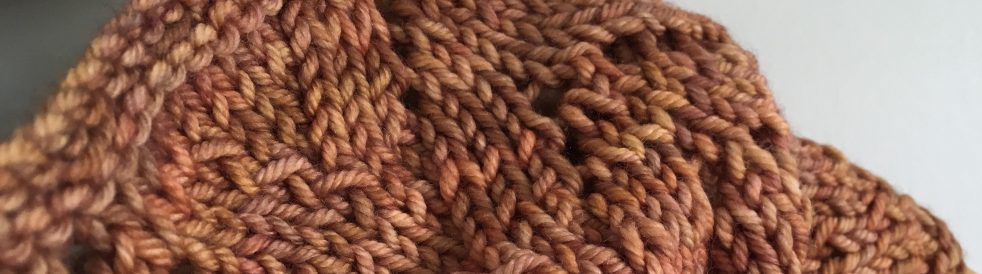
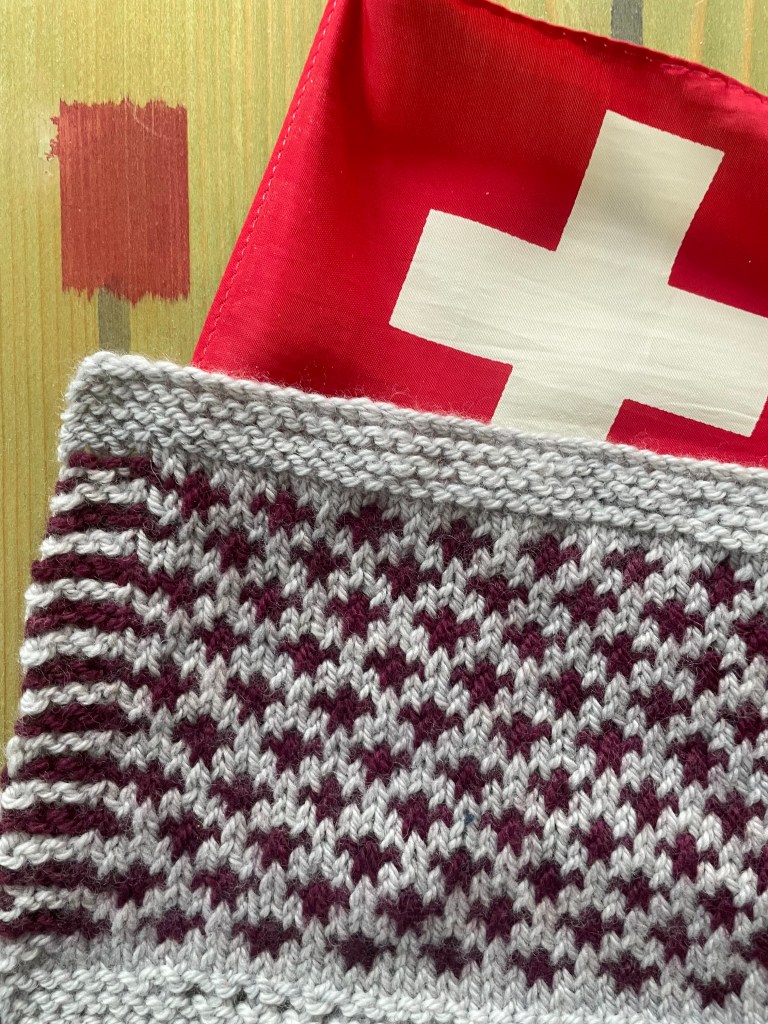
With my yarn caked, the pattern printed on cardstock, and the third swatch having met gauge using my new blue-and-gold interchangeable needles, I am ready to cast on Kleine Cardigan. Marie Greene’s new design pays homage to the Swiss flag although I opted for a silvery gray and maroon color combo rather than the traditional red and white. This sweater will be knit bottom-up in one piece using organic merino hand-dyed in Kansas.
Needles in hand I am ready to virtually explore Switzerland with hundreds of other Traveler’s Club participants.
Happy Knitting! Or, more appropriately, Viel Spaß beim Stricken!
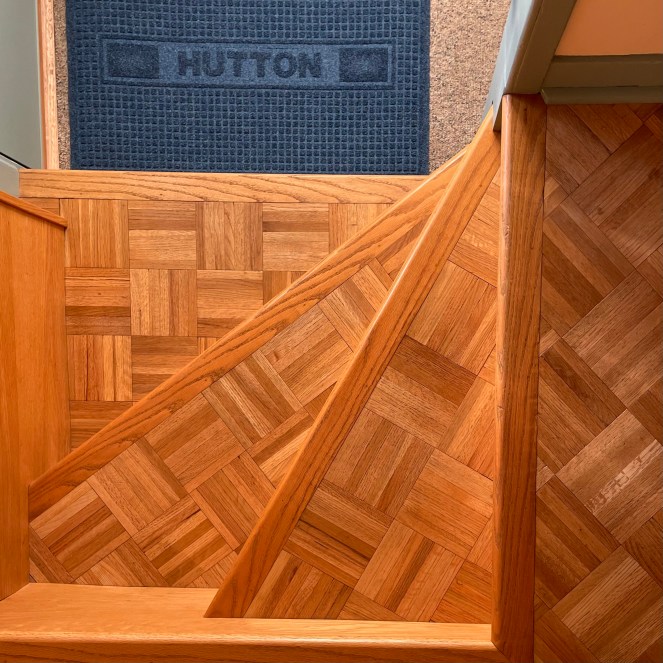
Through the efficiency of eSignatures, we signed with a realtor last week making it official that we are house hunting. This final GeometricJanuary post reveals just one of the barriers necessitating this life changing move from our multi-story, 100-year-old house to a step-free environment, boasting all the modern-day amenities on one floor. The turning parquet stairs with four angular steps to-and-from the back door is the shortest of the house’s staircases. While geometrically appealing, these steps are, at times, difficult to maneuver. In addition, there are other interior steps between some of the rooms and the exterior approach up the berm to the front door has two runs of steps. The quirks of our old house on a small lot with insufficient space to ramp would provide a significant challenge even for This Old House thus making our decision to move the reasonable choice.
A shout of appreciation to BeckyB for hosting this month’s photo challenge featuring square geometric images. I am looking forward to her next quarterly square challenge.
Sailing terminology is a coded mystery when one has only sailed twice (once on Lake Pepin and once on Tampa Bay with the St. Petersburg skyline in constant view). At first glance the rigging of the S.S.V. Niagara resembles an M.C. Escher lithograph – a tangled maze of confusion. But, when touring this tall ship in the Duluth harbor, we were assured that each Coast Guard trainee understood the complexity of the interconnecting boom, mast, and line.






 Knit+ Librarian