Reading

A Gathering of Poetry | May 2024

close up photograph of liliac blossoms

While our peonies are still tight buds, our two Miss Kim Lilacs will soon lavish our senses with purple blossoms and sweet fragrance, reaffirming exactly what poet Billy Collins knows about a spring day.

And, a thank you to Kat for the reminder that May days are passing and third Thursdays simply demand poetry.

Bibliographic credit:  Collins, Billy, Poetry magazine, © 2000

Photo credit:  Prexels – Pille Kirsi
Knitting

Celebrating May

small bouquest of lillies of the valley

I discovered French knitting designer, Solène Le Roux, in 2018. Her designs offered me a glimpse into the Parisian world of haute couture through a blend of simple elegance paired with stitches that are technically challenging enough to keep me alert and learning. In the early days of Covid, I joined her for a bilingual virtual retreat and then followed her move from Paris to the Château de Parançay in southwest France where she hosts knitting classes and fiber adventures.

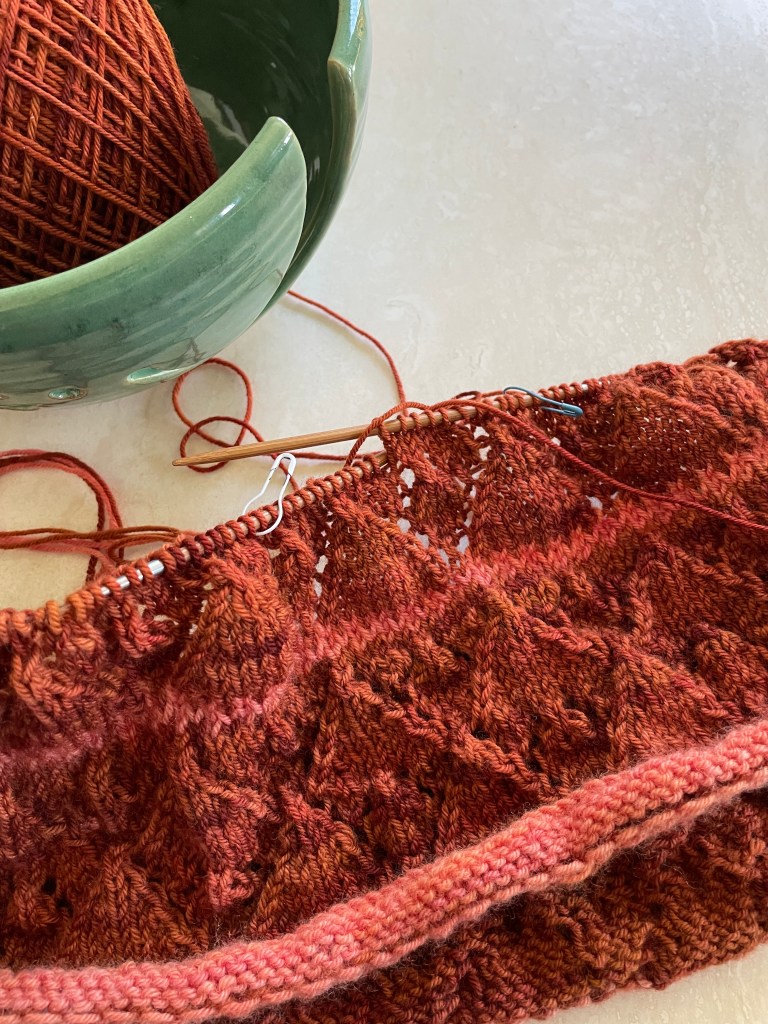
At the moment, I have a larger than normal number of items on my needles (two scarfs, a pair of socks, a twelve-month afghan, and a summer shawl). It feels quite frivolous to start another project, especially a mystery knit-along (MKAL) but then Solène is offering an “online knitting + meditation experience to celebrate Beltane and the month of May.” Since Clue #1 promised a variety of cables (my favorite design element) I cast on my Kala Mae mystery shawl using a rich tonal blue yarn, hand-dyed just up the river in Hastings at Muse2320.

Happy knitting!

Reading

Derek Anderson, 1969-2024

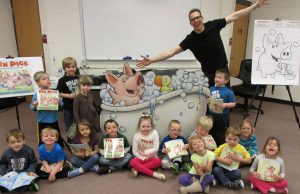
Author Derek Anderson and a group of children each holding a copy of his book, 10 Pigs

Today, I am re-reading the absolutely hilarious counting book, Ten Pigs: An Epic Bath Adventure – one of my favorites!  In 2016, I accompanied author/illustrator Derek Anderson on a round of library visits.  I sometimes acted as stagehand setting up the gigantic piggy bubble bath and, other times, I served as MC.  Derek enchanted hundreds of children, caregivers, and parents as the featured author in the Once Upon a Reader statewide one-book reading program that promoted the early literacy skills to Talk, Sing, Read, Write, and Play.  With wonderful memories of visiting libraries and having thoroughly enjoyed his ever-growing collection playful children’s titles, I am deeply saddened to learn of his death. Children’s literature and Minnesota libraries have lost a star.

Knitting · Travel

Park Shawl

Just off my needles is Christina Campbell’s International Peace Park Shawl. Her inspiration for this simple asymmetrical shawl knit in two colors, came from Waterton-Glacier International Peace Park, the world’s first international park and a UNESCO World Heritage Site.  The design begins and ends with solid segments representing the two bordering countries, color shifting stripes portray the mountain ridges, and the delicate lace segments depict the fragile nature of peace. 

My knitting journal usually documents December projects designed by Christina when I have joined 100s of other knitters participating in her annual Project Peace knit-alongs (KAL).  The delicate hand-dyed merino fingering skeins from last June’s Hand Dyed Happy Yarn Club are reminiscent of craggy peaks after snowmelt and spring flowers dotting high mountain meadows.  The pattern sat in my queue while I waited for that just right combo of yarns since, after three visits, Glacier National Park remains among my favorite natural places with these fond memories…

  • A mid-summer visit with nieces and nephews when thirteen of us hiked a glacier trail.  The sun sparkling so brightly off the snowpack there were sunburned calves, despite a slathering of sunscreen. 
  • When, despite a sunny June day, we could only venture as far as Lake McDonald Lodge as heavy, late season snowfalls blocked Going-to-the Sun Road.
  • And the thwarted plans to visit Glacier’s Canadian counterpart, Waterton Lakes National Park of Canada, due to lack of proper documentation.  We had incorrectly assumed drivers’ licenses were sufficient IDs and we learned (too late) that without our passports, US customs would not allow reentry.  Instead, we simply enjoyed rustic Rocky Mountain scenery on our side of the border.

Happy knitting on happy trails!

Baking

First taste of spring

two rhubarb scones on a blue plate with one stalk of rhubarb resting along the top edge

While technically a vegetable, rhubarb (tart and firm) enables a baker to make that first garden foray into spring, most often transforming garden goodness into sweet confections. The emerald green, heart shaped leaves emerge after snowmelt with just a few sunny hours during blustery spring days.  The tastiness of deep summer fruits like blueberries and cherries is still just a dream; hidden in the tight buds whose flowers have yet to reveal themselves in riotous color.  Like generations of bakers before me, our rhubarb patch called to my morning creativity and tomorrow we will enjoy a favorite sweet concoction, Rhubarb Pecan Scones.  

With bibliographic appreciation to Kim Ode and her book, Rhubarb Renaissance, published by the Minnesota Historical Society Press, 2012, as part of the northern plate series.

Knitting

Double Diamond Cowl

With seven cowls tucked away in tissue paper with protective lavender sachets, I recognize I should pause from knitting any more of these wardrobe accessories.  This particular article of clothing is a favorite among pattern designers.  As proof, I need only refer to the last three collections of new patterns that I’ve bought.  Within the knitting universe, cowls provide a quick project that often enables the knitter to explore a new or challenging technique on a small scale with the added benefit of putting into service a beautiful, but solo skein of yarn.  I am less certain of their popularity among those seeking soft, squishy neckwear.

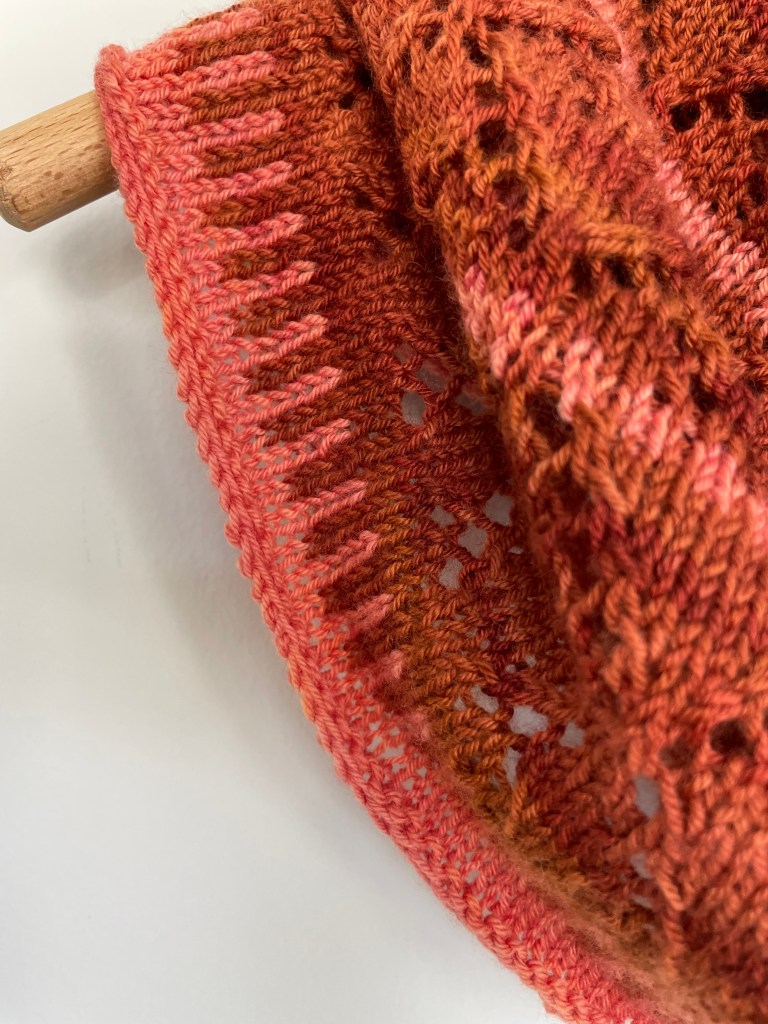
My latest finished object features a two-tone, double-diamond lace pattern.  Rather than relying on bold contrasts, the color shifts are subtle.  The pattern specifically called for “analogous colors – or colors that fall next to each other on the color wheel.”  The Double Diamond Cowl is part of Marie Greene’s recently released D is for Diamonds Stashbuster Series.  Fully embracing the spirit of the project, this fingering weight yarn came from my stash of lovely hand-dyed fibers acquired while participating in Heather Best’s Hand Dyed Happy Yarn Club

Happy knitting!

Knitting

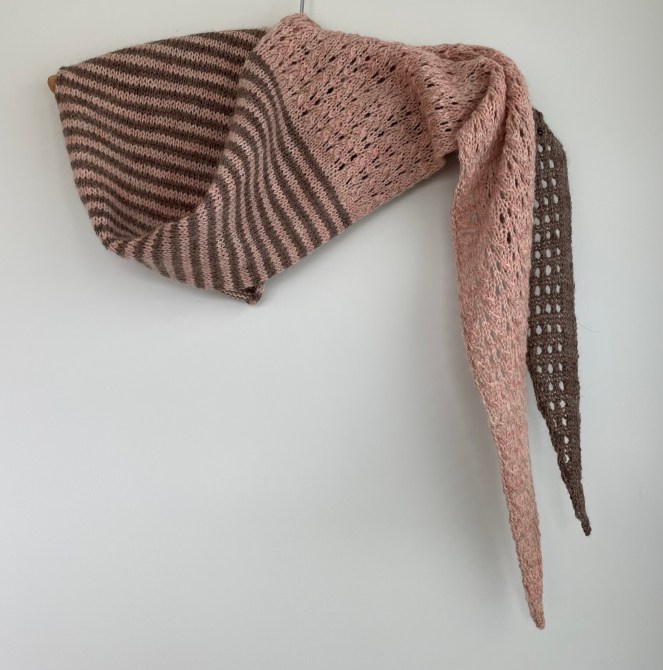
My Duet is a Trio

pale pink and light brown handknit scarf with stripes and lace

When I began my version of the Duet Triangular Scarf, I fully intended to color inside the lines and follow the pattern instructions. However, while my swatch met stitch gauge, I neglected to check row gauge.  As a result, the first segment revealed a delicate lace design with the correct width, but it did not match the intended length.  Guessing the same would be true for the opposite triangle and wanting a slightly longer scarf, I modified Marie Greene’s recently released pattern by adding a rectangular middle section.  This change eliminated the distinct seam between the two colors and created a gentle transition of skinny stripes alternating between pale pink and the natural, undyed light brown of this Peruvian highland wool.

Happy knitting!

Knitting

Fritillary Socks MKAL

logo for fritillary sock mystery knit along with bright pink blossoms nestled in a dewy field

With only a trio of socks to my credit and having sworn off this particular article of clothing 1,258 days ago, a new mystery knit-along (MKAL) has piqued my interest.  The five clues that will evolve into the first sock will be released April 1 (no fooling) through April 13.  Then I get to do all the work again to make the pair, hopefully, finishing in time for the second sock party just days into May.

Fritillaries, a flowering herbaceous perennial with bell-shaped blossoms, inspired this new knitting pattern.  Whether the design will capture the delicate checked petals is yet to be discovered but the pre-clue notes promise cables – my favorite stitch.

Happy knitting!

Graphic credit:  © Marie Greene

Knitting

Knit for Food Knit-a-Thon Today

graphic for knit for food marathon with a banana, steam rising from a bowl, a peanut butter jar, bread, apple and a ball of yarn with knitting needles

The beauty of retirement is the flexibility to decide whether to knit or swiffer the living room floor; to knit or reorganize the kitchen utensil drawer.  I framed my task list weeks ago when I registered for today’s Knit for Food Knit-a-Thon.  As part of Marie Greene’s team, I will join her and 6,000 others knitting through the day.  There are Zoom links connecting knitters, crocheters, and crafters for this 12-hour marathon that will raise funds and awareness for food insecurity.  The money will be equally divided among Feeding America, World Central Kitchen, No Kid Hungry, and Meals on Wheels.

Graphic credit:  © Marie Greene

Reading · Spirituality

Lectio Divina Revisited

graphic depiction of a flaming chalice on a blue quilted background

The practice of reading, thinking, and praying about a line of scripture was a frequent exercise during my Franciscan and Benedictine school years.  At the time, I did not know this by its Latin name, Lectio Divina, but I received a renewed introduction to this practice last evening.

Possibly because of the widespread dissemination of the Rule of St. Benedict, I associated the four-step practice:  read, meditate, pray, contemplate, with St. Benedict (480-547 CE) when its origins are earlier and have been adapted through time.  There is a Franciscan variation designed by St. Clare of Assisi (1194-1253 CE) and, following St. Ignatius of Loyola (1491-1556 CE), the Jesuits expand their mediation into action.

Recognizing that wisdom may be drawn from many sources, a 21st century adaptation of the Lectio Divina encourages the participant to dwell on sacred words beyond just those of a biblical origin but still integrates four thoughtful steps:  begin, pause, reflect, contemplate.

Begin:  Read the text slowly.

Pause:  Let the words settle.

Reflect:  Meditate, pray, or write.

Contemplate:  Identify what the text calls you to do.

The appeal of Benedict’s Divine Order is that each day’s text is predetermined. The reader joins a communion of others contemplating those same words.  There is extra work required to expand the Lectio Divina to include a modern collection of poetry. Today, on a third Thursday Gathering of Poetry, I will begin my Lectio Divina with words from Lucille Clifton.

True, this isn’t paradise,

but we come at last to love it

for the sweet hay and flowers rising,

for the corn lining up row on row,

for the mourning doves

who open the darkness with song,

for warm rains and forgiving fields,

and for how, each day,

something that loves us

tries to save us.

Graphic credit:  © Peg Green