Spirituality

A Sunday Reflection on Hope

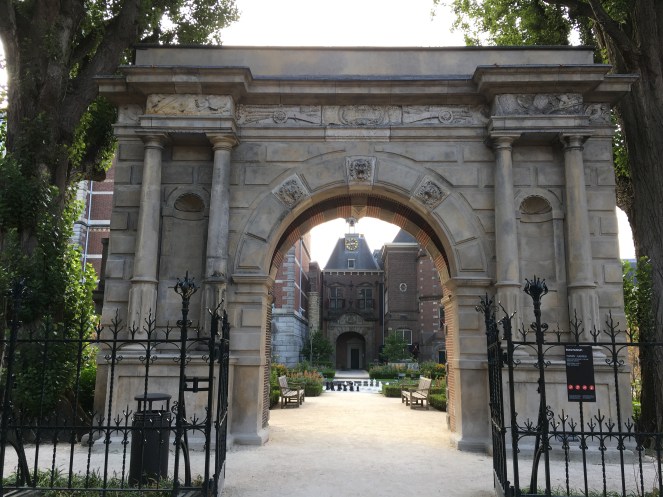
large stone gate at Rijksmuseum in Amsterdam

During my library career a favorite activity was introducing new library boards to their responsibilities. And, not just those duties required by Minnesota statutes, but those responsibilities entrusted to them as caretakers of a community jewel. While there are certainly those individuals who seek such an appointment (especially these days) with a goal of controlling the collection or banning certain books, over all the years, I found most people were interested in doing good within their community. People who believed in the importance of reading, the importance of a safe place, the importance of lifelong learning. They rarely recognized it, but library trustees are individuals of hope. After all, who but a person with hopes for the future builds a library, or a school, or a church? Who but a person hoping for positive change spends time and money supporting something that they might use only for a brief time but builds beyond themselves?

Acts of hopeful resistance take many forms:

  • When Richard and I submitted our Breaking Ground pledge form so that we can do just that this spring – break ground at Eliza Place.
  • When the offertory plate is passed and the funds we collect go out the church door to be shared with our social justice partners.
  • When we don our gold scarves and Side With Love t-shirts, whether on a sunny summer day or a frigid afternoon.
  • When we work side-by-side, shout out the injustice and work for change.

As this hectic month begins and I wonder how I will accomplish all the tasks – which cookies to bake, how to decorate the new house – last weekend’s snowfall served as a reminder to slow down and take a breath. To remember in these days of Advent that we are waiting for the gentle lights of Hanukkah, and Solstice, and Christmas. In these challenging days, I take solace from the poetic prayers of Rev. Victoria Safford, who reminds us we are at:

Spirituality

Multifaith Lawsuit: Protecting Places of Worship

gold background with outline of a heart in black with words in white block letters stating side with love

Mennonite Church USA et al. v. United States Department of Homeland Security et al., as filed on February 11, seeks to protect houses of worship as places of grace without government interference. More than two dozen Christian and Jewish denominations, representing millions of Americans, are co-plaintiffs in this lawsuit which asserts that ICE policy violates First Amendment rights of freedom of religion.

Throughout our country’s history, including the first administration of the current President, law enforcement considered churches, schools, and hospitals as “sensitive locations” protected from immigration enforcement. Among the many decrees effective on Inauguration Day, was a memo from the Department of Homeland Security rescinding the “sensitive locations” designation. This change in ICE policy makes way for immigration raids in churches even during religious ceremonies when refugees, asylum seekers, and immigrants might gather. The lawsuit confirms at least one such disruption during worship on a Sunday morning in Georgia.

As someone involved in liturgy, I want to focus on enriching the spiritual experience of participants; to lift the burden of a heavy heart, if only for a moment; to elicit inspiration through spoken words or sung lyrics. This change in government policy creates an unwelcome and unhealthy distraction. Now, I must shift my attention from the sacred to prepare for possible disruption.

The concept of sanctuary can be identified throughout history and across cultures, from Old Testament times to today. It saddens me that we must rely on the courts to determine that churches are different from coffee shops and strip malls. I sincerely hope Mennonite Church USA et al. v. United States Department of Homeland Security et al. is successful in protecting places of worship as holy and sanctified spaces.

For more information:

Press release from the Institute for Constitutional Advocacy and Protection, Georgetown Law, Georgetown Center for Faith & Justice

Press release from the Unitarian Universalist Association

Graphic credit: © Unitarian Universalist Association

Spirituality · Writing

Balancing Dreams and Budget: Pausing our church building journey

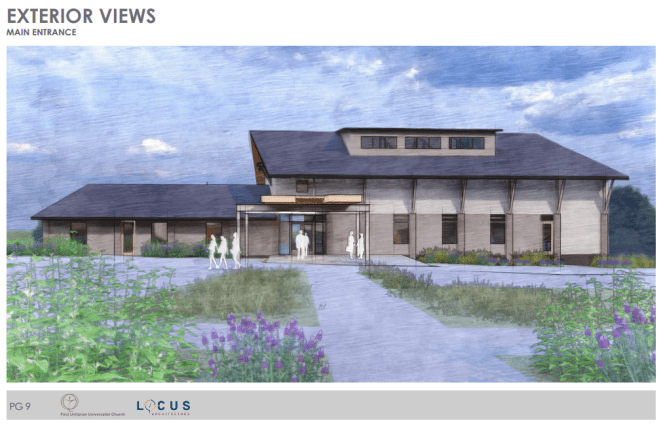
computer generated drawing of building with purple flowers in the foreground, dark roof and biege-brown walls
An exterior view from Locus Architecture following the schematic design phase of development.

I am a pen-and-paper note taker, a behavioral remnant leftover from long-ago college history courses. As we began discussing a new church home, it was natural that I would jot down ideas shared by congregants, whether during large group forums or even while enjoying a one-on-one coffee time conversation. Those notes evolved into an eight-page, single spaced, bulleted list. The ideas range from a visible entrance to natural light in the sanctuary; from an industrial kitchen to chairs with book racks for the hymnals; from energy efficient construction to a dedicated space for young adults. Some requests were overly broad – good acoustics. Others offered minute description – bench seating in the coat room for ease of putting on and taking off boots, with built in AC powered cubby holes to store and charge electric bike batteries during Sunday morning worship. Despite its length, the list contained very few contradictions. Even when there were preferences, for example, one-story versus two, Rev. Victoria Safford’s words captured the overarching sentiment which called for “a building that sits gently on the land.”

After seven years, through discernment, three congregational votes, a successful capital campaign, and reams of architectural renderings, we have a beautiful schematic design. Now we must pause.

There are a variety of factors conspiring against our project: current commercial interest rates are discouraging developers, and the design and location of our current building requires a unique buyer in a niche market. Add to this, the post Inauguration Day chaos and Presidential Executive Orders that, in the stroke of a pen, eliminated significant energy funding, as well as the threats of tariffs that will increase the costs of already expensive building supplies. A pause is prudent. My rational mind acknowledges that continuing to refine the architectural elements would be fiscally irresponsible, but my heart wants to buy a lottery ticket or host a bake sale or two or three. How to reconcile mind and heart?

With our most recent schematic design in hand, I decided to review the list and compare the dream with the elements on paper. In keeping with our vision statement for this land and the building: Do we have a design that will contribute to a compassionate and welcoming environment? How might this space contribute to our justice work? How inclusive have we been of the congregation’s creative suggestions?

Without the benefit of any scientific methodology, I rate our efforts: B+ to A-. The design incorporates many of congregants’ top priorities:

  • Large windows in the sanctuary with a panoramic southern view of the rustic landscape
  • A building footprint that can be expanded east and west to meet growth over the next 100 years
  • Easy workflow in a large kitchen.

Some highly desirable elements such as, the solar array or geothermal heating and cooling, are currently off the table due to cashflow. At best, we will build the needed infrastructure and add these highly-desired energy efficiencies in the future.

The questions that fill my mind these dark winter nights , as well as on snowy-bright days, are less about spreadsheets and the discrepancy between revenue and expenditure but focus on the nebulous side of the human psyche. How do we maintain the congregational momentum that got us to this point? How to convey that this project is like working on a post-graduate degree or taking the vacation of a lifetime, the dream will happen just not next year? How to gain financial support from everyone and spur our generous donors to give more? How to refine the design to realize cost savings without losing the heart and soul of the project?

While I do not wish sleepless nights upon any of my building team members or fellow congregants, we have a hard task ahead. Everyone’s thoughts and creativity will be needed and, maybe even, a lottery ticket.

Spirituality

Creating Margins

geese on open water with snowy trees in foreground

If there were weather badges, I would wear winter proudly on a scout-like sash. When friends question why we live in Minnesota, this land of 10,000 frozen lakes, I extol the efficiency of our Toro electric snowblower. When family members encourage us to move where winter temperatures are more moderate, I describe the warmth of my 10-inch, shearling-lined L.L. Bean boots and the safety of their legendary chain-tread sole.

In November and December, the blog posts I was reading, the poetry that landed in my in-box, and even the Sunday morning worship readings often focused on the change of seasons – autumn to winter; harbingers of shorter days and chilly winds necessitating down filled jackets. While not going so far as to advocate hibernation like a black bear, these readings encouraged taking a cue from nature to rest; to slow down and allow space for reflection and, maybe, creativity.

On winter solstice we light candles and sang of that “gentle darkness soft and still.” This year, more than any other, I felt the need to rest and re-charge. As I left church that evening my intention was to breathe deeply; appreciate the dark evening sky and embrace the quiet.

Yet just 10 days later, amidst bubbly toasts and video images of firework displays from Sydney to London, I was ready to surrender to mass media’s flurry of new year’s suggestions all urging “do more.” It was as if the small act of pinning a new calendar on the kitchen wall infected my mind. Rather than mere seconds passing at midnight, one day to the next, one year to the next, I felt I was eons beyond that “gentle darkness soft and still.”

Musician Carrie Newcomer helped me step back from that frenzy and from creating a checklist of busy work, a worksheet of old actions. She proposed moving away from New Year’s resolutions, the resolving of old problems and shifting to New Year’s revolutions. She wrote:

As January progresses, I continue to be resolute in my decision to join Carrie Newcomer with a New Year’s revolution. I will strive to revel in that which gives joy (despite the fractious political environment.) To explore the art of creating margins and leaving space for the unexpected – whether walking in the woods, discovering a previously unknown poet, or answering a call to justice. To remain open to the changing world “full of things that have never been.”

Spirituality

The Paradox of Both-And

graphic doodle image of a seated individual centered on a large heart shape

A recent weekend retreat provided time to feed my soul through calm introspection. Together, with more than 50 women, I explored the theme (Be)Coming: Meditations on Sacred Intersections.

At a time when it feels as if every decision is – this or that, right or left – it is unusual to consider a both-and opportunity rather than either-or choice. The retreat theme, the keynote presentations, the small group discussions, and our activities explored paradox. The idea that at first blush something may appear contradictory but with closer reflection a beautiful, intermingled tapestry may be discovered with the prospect of both-and.

As previously experienced, the sound meditation and “walking” a labyrinth, if only with my fingers on paper, were refreshing. New to me was the mudra we repeated throughout the weekend which incorporated symbolic hand gestures as used in various spiritual and cultural practices while reciting peace-focused words. Our time together provided a nice balance between quiet reflection and intellectual content all with the added attraction of staying in Rochester and sleeping at home rather than a conference center dormitory.


Doodle graphic: © 2024 Emily Morgan

Reading · Spirituality

Lectio Divina Revisited

graphic depiction of a flaming chalice on a blue quilted background

The practice of reading, thinking, and praying about a line of scripture was a frequent exercise during my Franciscan and Benedictine school years.  At the time, I did not know this by its Latin name, Lectio Divina, but I received a renewed introduction to this practice last evening.

Possibly because of the widespread dissemination of the Rule of St. Benedict, I associated the four-step practice:  read, meditate, pray, contemplate, with St. Benedict (480-547 CE) when its origins are earlier and have been adapted through time.  There is a Franciscan variation designed by St. Clare of Assisi (1194-1253 CE) and, following St. Ignatius of Loyola (1491-1556 CE), the Jesuits expand their mediation into action.

Recognizing that wisdom may be drawn from many sources, a 21st century adaptation of the Lectio Divina encourages the participant to dwell on sacred words beyond just those of a biblical origin but still integrates four thoughtful steps:  begin, pause, reflect, contemplate.

Begin:  Read the text slowly.

Pause:  Let the words settle.

Reflect:  Meditate, pray, or write.

Contemplate:  Identify what the text calls you to do.

The appeal of Benedict’s Divine Order is that each day’s text is predetermined. The reader joins a communion of others contemplating those same words.  There is extra work required to expand the Lectio Divina to include a modern collection of poetry. Today, on a third Thursday Gathering of Poetry, I will begin my Lectio Divina with words from Lucille Clifton.

True, this isn’t paradise,

but we come at last to love it

for the sweet hay and flowers rising,

for the corn lining up row on row,

for the mourning doves

who open the darkness with song,

for warm rains and forgiving fields,

and for how, each day,

something that loves us

tries to save us.

Graphic credit:  © Peg Green

Spirituality

A Year of Choices

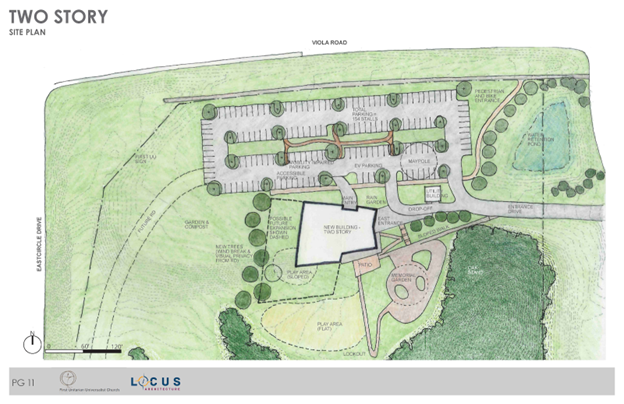
architectural drawing showing the potential layout on the new church property prepared by Locus Architecture
A preliminary design from Locus Architecture and one of many choices

After years of discernment during which we studied what was merely possible, defined what might be potential, and created a long wish list, 2023 has become a year of choices.  Two congregational votes clearly defined our direction.  Our first choice being the “stay/go” vote in January which set us firmly on the path to leave a building that has been home for 55 of our 157 years in Rochester.  Then came the second and equally momentous April vote authorizing the purchase of 38 Acres on Viola Road – that intersection of public witness and preserved wilderness – our choice of place where this liberal faith community may thrive.  And, our choices continue.

Locus Architecture presented two preliminary designs earlier this month after wading through a very long wish list, reviewing pages and pages of notes which captured the ideas voiced at more than 15 listening sessions held this spring, and participating in hours of conversation with the Building Our Future team.  The emphasis being on “preliminary” since our task of choosing continues:  1-story or two?  What constitutes the best blend of adjacencies?  Sanctuary and large gathering space on one level or large gathering space leading directly to the wide outdoors?  Ground or roof-mounted photovoltaic system or a combination?  Do we simply meet “code” or exceed minimum building requirements, especially if we feel the code crimps our values.  And, through all these discussions, just out of sight but waiting in the wings, are the financial decisions.  Just what will it take to realize our choices and turn our vision into constructed reality?

Based on the voices of the congregation, the Building Our Future team crafted a Vision Statement for the Building and the Land.  This statement introduced the architects as they presented their preliminary designs to the congregation; it was shared again at the dedication of the land on a sunny Sunday afternoon, September 17, and it is frequently chosen as chalice lighting words to focus our work at building team meetings.  Every day these words guide our choices.  In the days, weeks, and months ahead, more opinions will be needed from each member and friend of the congregation before we break ground in September 2024 and dedicate a new building a year later.  We do so with the hope that each choice will work towards our vision.

A Vision Statement for the Building and the Land

May we:
Welcome people with inclusive spaces and universal access.
Nurture spirituality and personal growth with beauty, art, and inspiration.
Practice justice with eco-restorative design.
Expand our community with flexible and multi-purpose space.
Create joy and resilience with places for play.
Care for sacred space to honor ancestors and nature.
Grow by embodying the intersection of public witness and preserved wilderness.

May it be so.  Amen.

Graphic credit:  © Locus Architecture

Spirituality

Our time to dream

graphic depiction of a chalice and flame surrounded by 2 circles

Together, our church community has been engaged on a critical path of Building Our Future activities.  We find ourselves, as a congregation, its members and friends, in the midst of a great call for creativity.

After a successful congregational vote supporting the purchase of the Viola Road property as our future church home and having concluded that purchase this past week, we are entering into what our board president has described as, “our time to dream.”

I can sometimes be a broken record.  I never miss an opportunity to remind anyone who will listen that there is a long wish list for our new space; a list that has been growing since 2019 with heartfelt suggestions offered at forums and casual comments shared during mahjong games in the Chapel.  But even with this long bulleted list, I believe there is more creativity out there. 

Rest assured, the Building Our Future team is grounded in reality and we know that not everything will be possible whether prohibited by cost, or time or discovering that today’s technology is not quite ready for the future we want.  Even knowing that, we want to hear everyone’s dreams. Every idea will be held tight and, if not incorporated into our 2025 building, then that bit of dream will be saved and maybe implemented in 2035 or 2050 or even 2125.

I feel the advice shared by Rev. William Sinkford’s in a recent article entitled “On Predicting the Future” pertains to what we are doing – Building Our Future – Beyond Ourselves. His words were intended to offer guidance as congregations continue to re-gather and try to understand how we, as faith communities, will behave after having lived through a significant worldwide experience.  But I believe his message is not just about post pandemic activities but also about how we acknowledge; how we embrace change.  His article is based on an essay by the award winning science fiction writer Octavia E. Butler and her rules for predicting the future:  In that essay she wrote:

All that you touch
You Change
All that you change
Changes you
The only lasting truth 
Is Change

I know our congregational world is changing, that this beloved community will be simultaneously the same and different in a new church home.  In the early morning hours, I will admit to the same worries and concerns that may be on each member’s mind and in each heart when thinking about the magnitude of this project.  But then I look at the person next to me at a Tupper Supper, I look at the faces of people sitting in the sanctuary on a Sunday morning and the librarian in me begins cataloging the depth of the talent pool, the variety of skills in our toolbox and I am infused with confidence.

We have over 150 years of history in this community; a history that includes drawing blueprints, fundraising, constructing, and moving into four different buildings. But before any of that hard work began so many times before, so many years ago, before ground was broken, or rafters set, before church bells were hung or buildings dedicated, those that came before us dreamed of what their new home might be.  So let creativity soar and let us dream of the place Rev. Luke has described as:

“A church at the intersection of public witness and preserved wilderness. . . A Sanctuary for community, for nature, and the soul.”

It is our time to dream.

Graphic credit:  Chalice Art © Karin Lindsey

Spirituality

“Wrapped in blue cloud cloth…”

heart shaped antique glass Christmas ornament on tree with three lights (blue, red and yellow)

We celebrated my Mom’s 99th birthday on Thursday.  She still lives in the house my Dad built 60 years ago.  During the past few months, she has undertaken a new task – finding those things she has not used in years and feels she no longer needs.  Nearly every day, when I call her, she proudly describes what she has moved to the small green bedroom (her designated collection point) there to await my next visit when I will deliver these gently used items to the thrift store.

Following her example, I have started de-cluttering our house.  It is amazing just how much stuff is tucked up on closet shelves, hidden in desk drawers, or stashed in the way-back corner of the bottom kitchen cupboard; items that certainly served a purpose or filled a want but which have mostly been forgotten.  It feels good put into practice the three Rs – reduce, recycle, reuse..

My first thoughts about 2023 were tinged with wariness.  After all, this past year was filled with false starts and yet more uncertainty.  Then I began nudging myself toward a change in attitude; if only a shift in semantics.  Rather than looking at the coming tomorrows with trepidation, I am trying to change my language and look at the new year as time of mystery; balancing cautiousness and excitement; looking at the days ahead with a sense of wonder. 

I recently rediscovered a volume of poetry by Langston Hughes, originally published for children, but with lyrical phrases that offer weighty advice to children of all ages.  His poem, “The Dream Keeper” gave me insight as to how I might approach my attitude adjustment.  He wrote:

Bring me all of your dreams, 
You dreamer,
Bring me all your
Heart melodies
That I may wrap them
In a blue cloud-cloth
Away from the too-rough fingers
Of the world.

That phrase “That I may wrap them in a blue cloud cloth” rang true as I gently wrapped my Grandmother’s heart-shaped mercury glass ornament and put it away for another year; carefully handling the fragile heirloom all the while joyously celebrating childhood memories and thoughts of future holidays. 

The poet’s words also reminded me that my hopes for today and tomorrow will need tender protection from “too rough fingers of the world” and that I need to keep that “blue cloud cloth” close at hand so that I might safely wrap my dreams while looking for the wonder and the mystery in the days ahead.

Happy New Year!

Spirituality

Enter the Season with Intent

a box of chocolates with white numbers for each day of December

Growing up, my Advent calendar was made of decorative blue cardboard with simple paper flaps that folded back and revealed religious holiday images:  an angel, a star, a shepherd and, eventually, a nativity scene.  Since it was used year after year, the flaps didn’t always stay closed which allowed this impatient child to sneak a peek at the treats for the coming days.

My 1950s calendar was very simple compared to what is available today.  If you do a quick search you will find a multitude of themed choices ranging from chocolate to wine.  There is even a Lego Advent calendar, although daily assembly is required. 

Lest you worry that knitters have been forgotten, there are patterns featuring a different color or design for each day of Advent.  These are usually built around 24 days of surprises so that the hat or scarf can be gifted on Christmas morning.  Periodically, a yarn store may offer a very pricey calendar that contains 25 unique skeins providing the recipient with a daily tactile experience and the added benefit of stash building.

Such varied product availability is the reason that after surviving months of political endorsements, we are now inundated with holiday ads all promoting a sense of “must have-ness;” ads with the potential to take us further and further away from the original intent of the seasonal holydays of Hanukkah and Christmas.

Hanukkah – the festival of lights, commemorating a time of miracles when the faith of the Jewish people sustained them to reclaim their holy temple and keep the light of the menorah burning for eight days.

Advent – the weeks of preparation before Christmas, the celebration of the humble birth of Jesus in a stable; days that Rev. Megan Lloyd Joiner calls “the waiting time.”

But waiting can be hard especially when Christmas-themed stores are open year-round and two-day delivery requires just a click of the mouse.  In a society reveling in perpetual motion, the idea of waiting is often translated into a sense of doing nothing.  That we are somehow disloyal or disconnected if we seek the quiet or admit to being overwhelmed by the barrage of 24/7 news reporting on the war in Ukraine, or volcanic eruptions in Indonesia, or the nearly daily gun violence in the United States. 

For this feeling of disconnection Rev. Joiner offers this advice “…not just to wait, but to wait actively:  to do the work of preparing hearts and tilling the soil that awaits seeds of hope and love … to be present in each moment of waiting.”

Or as Rev. Luke Stevens-Royer preached last Sunday in his annual “Humbug” sermon there is “the reminder to slow down, be it by blizzard of the sky or blizzard of the soul.  That to pause, to wait, to rest, is not an invitation to isolation or hibernation but, when the world feels like storm, it is our natural reminder to pause … to find ways of entering the season with intention.”  

With the beginning of Hanukkah yesterday at nightfall, as Advent continues and as we approach the Winter Solstice when we explore seasons and cycles and celebrate the light of days growing longer (if only by seconds), may you enjoy lighting a candle (or eight); may you “be present in each moment of waiting” and may you “find ways of entering the season with intention.”

Photo credit: Marcus Spiske from Prexels