Knitting

My Duet is a Trio

pale pink and light brown handknit scarf with stripes and lace

When I began my version of the Duet Triangular Scarf, I fully intended to color inside the lines and follow the pattern instructions. However, while my swatch met stitch gauge, I neglected to check row gauge.  As a result, the first segment revealed a delicate lace design with the correct width, but it did not match the intended length.  Guessing the same would be true for the opposite triangle and wanting a slightly longer scarf, I modified Marie Greene’s recently released pattern by adding a rectangular middle section.  This change eliminated the distinct seam between the two colors and created a gentle transition of skinny stripes alternating between pale pink and the natural, undyed light brown of this Peruvian highland wool.

Happy knitting!

Knitting

Fritillary Socks MKAL

logo for fritillary sock mystery knit along with bright pink blossoms nestled in a dewy field

With only a trio of socks to my credit and having sworn off this particular article of clothing 1,258 days ago, a new mystery knit-along (MKAL) has piqued my interest.  The five clues that will evolve into the first sock will be released April 1 (no fooling) through April 13.  Then I get to do all the work again to make the pair, hopefully, finishing in time for the second sock party just days into May.

Fritillaries, a flowering herbaceous perennial with bell-shaped blossoms, inspired this new knitting pattern.  Whether the design will capture the delicate checked petals is yet to be discovered but the pre-clue notes promise cables – my favorite stitch.

Happy knitting!

Graphic credit:  © Marie Greene

Knitting

Knit for Food Knit-a-Thon Today

graphic for knit for food marathon with a banana, steam rising from a bowl, a peanut butter jar, bread, apple and a ball of yarn with knitting needles

The beauty of retirement is the flexibility to decide whether to knit or swiffer the living room floor; to knit or reorganize the kitchen utensil drawer.  I framed my task list weeks ago when I registered for today’s Knit for Food Knit-a-Thon.  As part of Marie Greene’s team, I will join her and 6,000 others knitting through the day.  There are Zoom links connecting knitters, crocheters, and crafters for this 12-hour marathon that will raise funds and awareness for food insecurity.  The money will be equally divided among Feeding America, World Central Kitchen, No Kid Hungry, and Meals on Wheels.

Graphic credit:  © Marie Greene

Reading · Spirituality

Lectio Divina Revisited

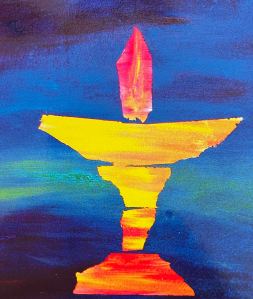
graphic depiction of a flaming chalice on a blue quilted background

The practice of reading, thinking, and praying about a line of scripture was a frequent exercise during my Franciscan and Benedictine school years.  At the time, I did not know this by its Latin name, Lectio Divina, but I received a renewed introduction to this practice last evening.

Possibly because of the widespread dissemination of the Rule of St. Benedict, I associated the four-step practice:  read, meditate, pray, contemplate, with St. Benedict (480-547 CE) when its origins are earlier and have been adapted through time.  There is a Franciscan variation designed by St. Clare of Assisi (1194-1253 CE) and, following St. Ignatius of Loyola (1491-1556 CE), the Jesuits expand their mediation into action.

Recognizing that wisdom may be drawn from many sources, a 21st century adaptation of the Lectio Divina encourages the participant to dwell on sacred words beyond just those of a biblical origin but still integrates four thoughtful steps:  begin, pause, reflect, contemplate.

Begin:  Read the text slowly.

Pause:  Let the words settle.

Reflect:  Meditate, pray, or write.

Contemplate:  Identify what the text calls you to do.

The appeal of Benedict’s Divine Order is that each day’s text is predetermined. The reader joins a communion of others contemplating those same words.  There is extra work required to expand the Lectio Divina to include a modern collection of poetry. Today, on a third Thursday Gathering of Poetry, I will begin my Lectio Divina with words from Lucille Clifton.

True, this isn’t paradise,

but we come at last to love it

for the sweet hay and flowers rising,

for the corn lining up row on row,

for the mourning doves

who open the darkness with song,

for warm rains and forgiving fields,

and for how, each day,

something that loves us

tries to save us.

Graphic credit:  © Peg Green

Racing

20 Drivers & 24 Races – New F1 Season

red F1 Ferrari in the lead at hairpin corner at the Montreal Gran Prix June 7, 1998
Schumacher wins in Montréal for Ferrari – 1998

In not quite a decade, between meeting Richard (June 7, 1981) and June 1989, I went from watching races only sporadically to track side attendance at the inaugural Formula 1 street race in Phoenix. In my early days of race viewing, the challenge was simply finding a re-play of a race as only the “jewel” in the racing crown – Monaco – might, just might be aired in real time.

Six seasons of Drive to Survive has increased viewership and a variety of streaming services now ensures race coverage with experienced commentary. And, with more viewing my familiarity with tire degradation and slip stream passes also expands. The longest season ever run started this weekend in Bahrain and we will follow this most expensive motor sport from lights out starts to checkered flag finishes all the way to Abu Dhabi.

Bahrain podium finishers: 1- Max Verstappen, Red Bull; 2- Sergio Perez, Red Bull; 3- Carlos Sainz, Ferrari.

Photo details:  Canadian Gran Prix, Montréal, Circuit Gilles Villeneuve, June 7, 1998.  Last lap, with Michael Schumacher in the lead and winning the race for Ferrari.

Knitting

Knit for Food Knit-a-thon

background teal fades to gold with bold white letters stating knit for food 03-23-24 with knitting ball and needles

I know what I will be doing a month from today on March 23 – KNITTING!

Inspired by Knit Camp leader, Marie Greene, I will join thousands of knitters and crafters in the Knit for Food Knit-a-thon 2024.  A day, that Marie describes, when “we can turn skeins of yarn into meals on tables, hope in hearts, and smiles on faces.”

This knit-a-thon is a 12-hour marathon to raise funds and awareness for food insecurity.  The event planners promise “100% of funds raised will be equally divided between Feeding America, World Central Kitchen, No Kid Hungry, and Meals on Wheels” and they have a track record validating their claim.  The previous three knit-a-thons, 2021-2023, raised $877,571!

Even if you are not a knitter, every craft-lover can participate because what is not to love about a day spent working with your favorite medium AND raising money for such a meaningful cause.  So join me in participating and donating to Knit for Food Knit-a-thon.

More information about the knit-a-thon recipients:

Writing

Remembering Elizabeth Klein

I have never thought of myself as a writer.  The practical skills needed to earn undergraduate and postgraduate degrees cemented basic composition skills.  These accompanied me through decades of professional obligations as I prepared copious amounts of monthly board materials, drafted legislative platforms, and crafted strategic plans.  Clear and concise never mingled with creativity.  Writing was an obligation and often a chore that I certainly was not going to perform in my limited free time.  Plus, with more than 45 years in libraries, the opportunities to meet published authors abounded and I knew those visiting poets and novelists were “real” writers.

Even though it has been decades since I chauffeured Elizabeth Klein through a packed schedule of author-in-residence workshops and poetry readings, she serves as my benchmark defining what makes a writer.  With funding from a state arts grant, we crisscrossed central Illinois visiting schools, libraries, and art museums.  She shared her poetry and then helped individuals write their own verse.  She described character development, using her recently published, award-winning novel, Reconciliations.  She declared that for her “writing is like breathing.”  Writing was so deeply ingrained in her conscious and subconscious that she could not imagine even a day without writing.  Her dedication to her craft was completely contradictory to my sentiments since I was happy to avoid writing whenever possible.

I surprised myself in May 2020 when I launched this blog.  At the time, I was simply seeking a creative outlet amidst our Covid quarantined days; a place to record, in words and images, tidbits of our life.  That decision led eventually to joining a writing group which has expanded my perspective. I now feel emboldened to self-identify as a micro-writer.  Micro as in – only a little.  Micro as in – needing small topics. 

This blog serves as my knitting journal.  A place where I showcase recent projects, reveal a complicated stitch, or share the origins of a pattern.  Infrequently, I will offer a few sidebars about the books I am reading or descriptions of our garden produce.  And now, with the gentle nudges of my fellow writers, I may bravely foray into more substantial topics as I sharpen the skills in my writer’s toolbox. 

Reading

Book Club: Tom Lake

Having migrated from Zoom sessions during those closeted days of Covid self-quarantine, The Directors gathered yesterday at a lunch locale for wine toasts, shared desserts and a book discussion.  While unusual but delightfully so, we discovered that this library loving, book reading, wine-drinking group of retired friends had landed on a title that we all enjoyed – Ann Patchett’s Tom Lake.

While I have become a regular audiobook listener when knitting, I know I would score miserably low should I take an Iowa Basic Skills comprehension test for any of those titles.  I still gravitate towards a hard cover for book club selections.  However, for Tom Lake, I was intrigued by the prospect of hearing Meryl Streep read this story and wondered if I would I hear the actress or the voice of the main character?  I opted to both read and listen.  I read a few chapters and then listened to those same chapters in the audiobook format.  At times, I recognized the text well enough that I could anticipate the next phrase and, then again, a detail I missed in reading the ink on paper would be a surprise in my ear.  Even though reading2 is time consuming, I may repeat this paper copy / audiobook combo for future book club selections.

Synopsis:  Three daughters listen and question their mother’s stories about her long-ago budding acting career on stage and screen, her first love, a spotlight on summer-stock, and her life choices; some made with intention and others by happenstance.  From the New York stage to poolside Hollywood to a cherry orchard in northern Michigan, the story gently shifts between past and present. Patchett artfully reveals common threads and the different hopes and dreams of each family member.

Reading

A Gathering of Poetry | February 2024

When I think about poetry in February, the images of red and pink children’s valentines from the mid-1950s spring to mind or syrupy sweet verses, so I took a different approach for this month’s Gathering of Poetry and visited Shel Silverstein’s Where the Sidewalk Ends for Love.

cartoon image holding a sign with a large V

Love

Ricky was “L” but he’s home with the flu,

Lizzie, our “O,” had some homework to do,

Mitchell, “E” prob’ly got lost on the way,

So I’m all of love that could make today.

And, thanks to Kat for reminding me that it is time for a third Thursday poetry post.

Bibliographic credit:  Silverstein, Shel. Where the Sidewalk Ends: the poems and drawings of Shel Silverstein.  Harper & Row. © 1974.

Knitting

Variations on a theme

At the pattern designer’s recommendation, I knit my first version of this shawl in a multicolored self-striping yarn. The lacy border took a back seat to the fabric’s vibrancy and I wondered what would result if I knit this same design with a solid or subtle tonal yarn. I quelled my curiosity first with the peachy project and then knit a second shawl in deep fuchsia. Both skeins had arrived in yarn club surprise packages and, utilizing good stash management practices, each just needed the right design.

The combination of fingering weight yarn and a slightly larger needle results in an airy body of garter stitches. An unusual double yarnover (yo2) at the beginning of the lace row creates an elongated fiber filigree. And, I added a little glitter by incorporating a pearlized pink Miyuki seed bead on each lacy tip. Now, wrapped in tissue paper, each shawl is safely tucked away awaiting a giving opportunity as a silent auction donation.

Happy knitting!