My experience tending cemeteries has involved cultivated flowers planted in the ground at the base of the headstones or in heavy pots on iron stands for the caretaker’s ease of mowing. So for years I envisioned a gardener’s precision as the poet’s first stanza describes flowers growing “between the crosses, row on row…”. The exacting symmetry of Arlington Cemetery or Colleville-sur-Mer in Normandy, France.
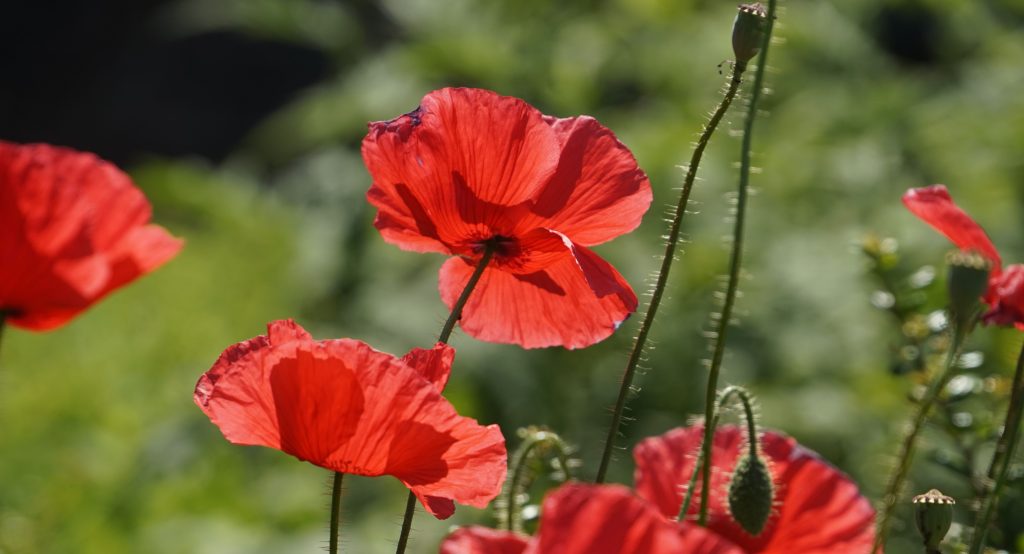
It was decades after reading John McCrae’s war poem in Mrs. Miggawa’s third grade class, that I learned the poppies in those Flanders fields sprang naturally from dormant seeds buried deep in war torn earth. Growth and life revealed even as incessant exploding bombs continued. Land torn by horse and caisson and trodden upon by thousands of war weary footsteps as soldiers scrambled “over the top” from trench to blood soaked No-Man’s Land.
In Flanders Fields is one soldier’s grief expressed in words after burying his friend following the Battle of Ypres in Belgium. A life lost in the Great War, that war to end all wars. A war that ended on the 11th hour, of the 11the day, of the 11th month – Armistice Day.
But while fighting ceased on November 11, 1918, peace was and remains elusive. From the Great War to World War II, to the Korean Conflict, to Vietnam, to Afghanistan, Iraq, Gaza, and Iran, it continues. On this Veteran’s Day, whether your red poppy is a paper boutonnière or a cascade of thousands of knit and crocheted yarn blossoms draped from an English church steeple, let us remember the significant loss of life and limb and work for peace.
In Flanders Fields

In Flanders fields the poppies blow
Between the crosses, row on row,
    That mark our place; and in the sky
    The larks, still bravely singing, fly
Scarce heard amid the guns below.

We are the Dead. Short days ago
We lived, felt dawn, saw sunset glow,
    Loved and were loved, and now we lie,
        In Flanders fields.

Take up our quarrel with the foe:
To you from failing hands we throw
    The torch; be yours to hold it high.
    If ye break faith with us who die
We shall not sleep, though poppies grow
        In Flanders fields.
Bibliographic note: John McCrae, poet. First published in the London-based magazine Punch on December 8, 1915.
Photo credit: pexel – Freek Wolsink

